Aller au contenu
Jouplast

Hidden-Decking Fixings

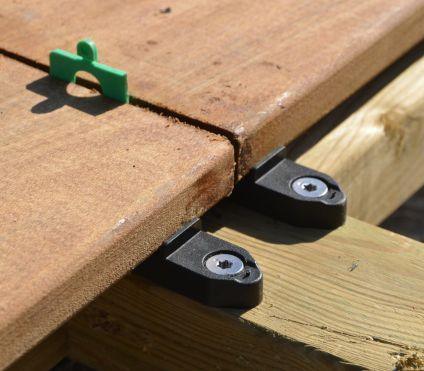
Fixego® is a unique hidden deck fixing system patented by Jouplast® designed to conceal your raised deck’s fasteners. This invisible decking fixing system allows you to create a natural timber decking area with no visible deck screws. It also ensures a consistent gap between the wooden boards and allows air to circulate between the wooden deck’s accessories.

Read more
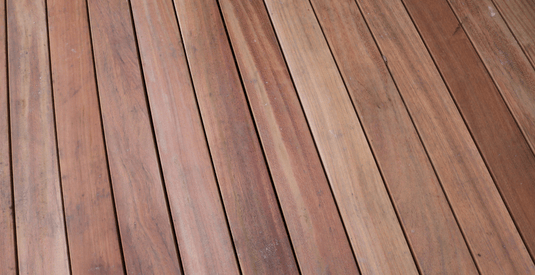
fixer-des-lames-bois-de-facon-invisible-fixations-invisibles-1 hidden decking fixings

Fixego®: hidden decking fixings for wooden decks

Fixego® is a unique hidden deck fixing system patented by Jouplast® designed to conceal your raised deck’s fasteners.

The Fixego® kit is available in two versions:

  • For decking boards from 19 to 25 mm thick
  • For decking boards 25 mm and thicker

This invisible decking fixing system allows you to create a natural timber decking area with no visible deck screws. It also ensures a consistent gap between the wooden boards and allows air to circulate between the wooden deck’s accessories.

Benefits of hidden fixings for decking

  • 100% invisible: thanks to the under-mount fastening system, your raised deck will no longer show any visible fasteners. It is both aesthetically pleasing and practical.
  • Lifespan: hidden decking fixings extend the lifespan of your elevated wooden deck by ensuring good ventilation.
  • Board replacement: with Fixego®, it is much easier to replace a damaged tropical or exotic wood board, for example. The time saved with this hidden fastening system is significant.
  • Strength: our hidden wooden decking fixings are resistant to UV rays, frost and tearing. The deck fasteners feature a special Silverplus treatment (easier to fasten) and Lubex treatment (highly resistant to corrosion).
  • Universal: this type of invisible decking fixing is universal and can be used on any type of boards.

Directions for use

Our hidden deck fixing system should only be used on outdoor raised patios intended for pedestrian use.

The moisture content of the decking boards should be between 18% and 22% at the time of installation, otherwise there is a risk that the structure will degrade over time.

  • It is recommended to use joists made from the same type of wood as the decking boards.
  • Using Fixego® with warped or unstable wood (g. acacia) is not recommended.
  • Before use, check the compatibility of the Silverplus-treated stainless steel screws supplied in the bucket with the type or characteristics of the decking boards (g. not compatible with Accoya).
  • Not compatible with composite decking boards.
  • Estimated installation time (average estimate for a skilled timber decking contractor): our estimates suggest that installing a raised deck with Fixego® takes 10% to 15% longer than with conventional techniques (as the preparation and installation of the joists are identical). The extra time is mainly used to begin the deck laying process, which is slightly more technical than conventional methods.

How to install the Fixego® hidden decking fixings

There are several steps to follow to install invisible decking fixings. Installation is easy and quick, but it is important to follow the steps below to ensure your deck’s durability.

Our recommendations

  • Carefully choose your timber. Selecting your materials and building the frame for the decking requires great care to minimise damage caused by poor hydrometry or bad weather conditions.
  • The wooden deck must be raised off the ground to ensure that the substructure is well ventilated. Use polymer shims or PVC pedestals as installation supports.
  • Ensure that the drying techniques for the decking boards meet the requirements for the selected timber species. This information should be verified with the wood distributor.
  • We recommend pre-drilling the decking boards, adjusting the depths of the holes to the different board thicknesses.
  • Choose the right structural timber. The quality of the timber used for the substructure is just as important, if not more so, than that of the decking boards. It is recommended to use joists made from the same species of wood as the decking boards, or from a higher grade.
  • In the case of unstable timber, in accordance with the wood distributor’s recommendations, reducing the centre-to-centre distance between joists minimises the risk of board warping.
  • We advise against using our Fixego® invisible decking fixings with joists less than 45mm wide. For joists between 45 and 65mm wide, we recommend using double joists. This will provide greater strength. For joists wider than 65mm, it is possible to join decking boards onto a single joist.
  • Over time, the colour of the wooden boards may take on a greyish appearance. This is a natural process where a thin surface layer oxidises due to UV rays and weather conditions. Use a grey remover and a brush to remove this grey layer. A colour-saturating oil matching the wood’s natural tone may also be used.
  • It is important, even essential, to draw up an installation plan before work begins in order to plan the cuts, the installation with or without adjoining boards as well as distances between the joists.
  • Installing Fixego® does not require any special material, apart from a drill.

Our installation tips

Now that we have covered all the prerequisites, here is our installation guide. Watch the video to learn how to build a raised deck with no visible screws using Fixego® hidden deck fixing system.

Read more
a question?

1. How to hide my decking pedestals?

There are several methods for concealing the joist pedestals on your raised decking.

If the clearance height allows it, you can create wooden side finishes for a uniform look.

For a finish at the end of the joist, simply place a lateral riser support on the base of the joist pedestal and snap off the tab. You can then more easily position and secure the joists. Do not forget to secure the vertical joist with a screw. You can finally attach the fascia board to the joist using 2 screws.

For a finish along the joist, you have two options:

  1. Create a “ladder” edge structure. To do this, you will first need to place a lateral rising support at the base of each pedestal and snap off the tab. Then, position perpendicular reinforcements around the edge to allow pedestal movement. Place a small vertical joist of the measured height against each lateral riser support and fix the fascia board to the joist using 2 screws.
  2. Add a peripheral joist. To do this, start by placing a lateral rising support at the base of each pedestal and snap off the tab. Then, position a small joist vertically against each lateral rising support and fix a spacer between the 2 peripheral joists to secure them together. Finally, simply fix the fascia board to the joist using 2 screws.

If your clearance height is too low, do not worry! We have alternatives to offer:

  1. Decorative pebbles can be an elegant solution. Placing pebbles along the edge of your decking will create a natural and attractive look that blends harmoniously into your outdoor living space. The pebbles add an organic and warm touch, whilst elegantly concealing the unclad sections.
  2. Another interesting finishing touch option for your raised decking is the use of small L-shaped corner pieces or finishing profiles. These 2×2 cm or 3×3 cm angles, depending on your needs, add a touch of structure and neatness to your deck. Easy to fix, L-shaped angles provide a stylish and durable finish to the edges of your elevated wooden deck.
PICT-FAQ-1
reassurance-1
OVER 60 YEARS

of existence at your service

reassurance-2
INCREASED RESISTANCE

to bad weather

reassurance-3
SUSTAINABLE SOLUTION

and environmentally friendly

reassurance-4
EASY TO INSTALL

thanks to our innovative systems